
Credit Card Statement Reading
This path provides an order of operations for a complete first review of an issued card statement.
- Credit Card Statement Balance vs Current Balance: Reconcile the Gap
- How to Check the Minimum Payment and Due Date
Learn how to read and analyze a credit card statement, check balances and due dates, understand APR and interest, investigate charges, and protect statement data.
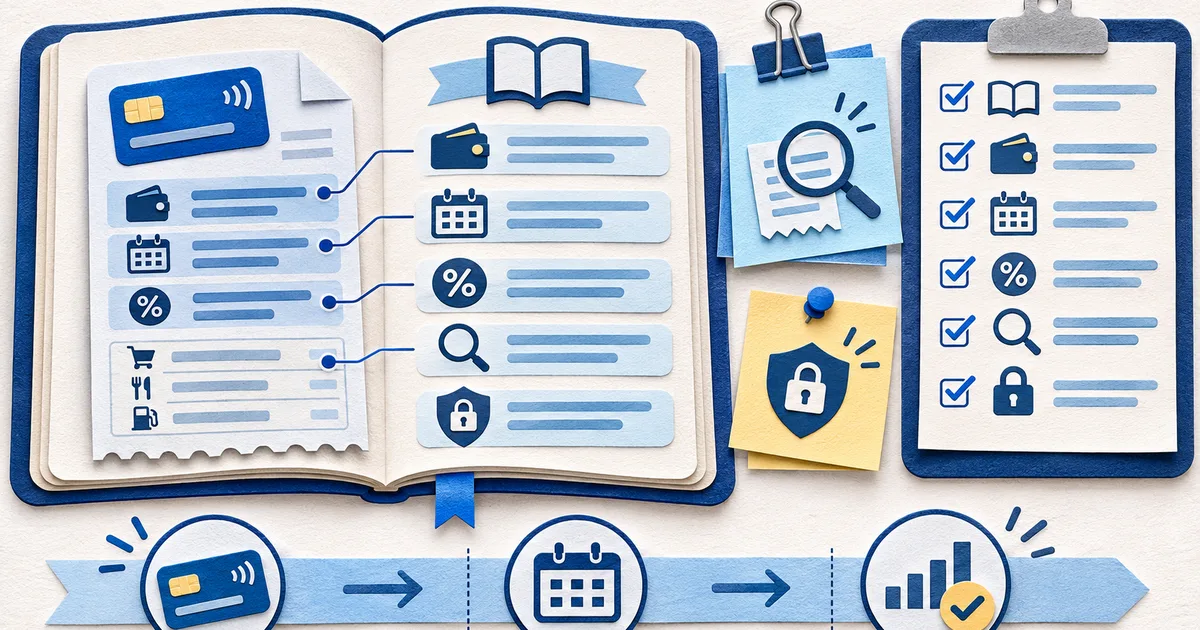
Each learning path answers one related group of questions, then connects you to three detailed guides and the most relevant analysis workflow.
This path provides an order of operations for a complete first review of an issued card statement.
Use this path when two legitimate account figures differ or a correction appears outside the original purchase cycle.
Use this path for the two most changeable parts of a card account: transaction state and borrowing cost.
Use this path to add meaning to transaction rows while keeping every conclusion reversible and evidence-led.
Use this path to locate which layer failed before changing a file, row, total, or account conclusion.
Use this path when the question is not merely what the statement shows, but whether a payment, fee, or correction was handled as expected.
Use this path before a statement leaves the cardholder's control or enters a new storage system.
Our editorial framework separates what appears on the statement from what it may mean. Rules and consumer-rights explanations are checked against official material, while issuer-specific decisions stay with your card issuer.
Use the deep statement reference libraryContinue into extraction quality, reconciliation, recordkeeping, multi-statement comparison, and other practical review tasks.
Begin here to understand what a card statement records, what it leaves outside the cycle, and how its sections work together.
2 detailed guidesUse this path when a statement must become structured data without breaking the trail back to its pages.
3 detailed guidesThis path turns statement evidence and ledger entries into a controlled matching process rather than a forced zero difference.
3 detailed guidesThis path explains the supporting role of a statement without treating a posted charge as proof of deductibility.
3 detailed guidesThis path is for period comparisons that explain change without pretending two cycles establish a long-term trend.
2 detailed guidesTurn statement rows into a traceable review, then use the matching guide to verify balances, dates, charges, interest, and uncertainty.
A verified cycle can be reduced to a net-cost view with the one-cycle credit card expense calculator, which keeps payments outside spending.
Teachers and interface testers can pair these workflows with the synthetic statement test-fixture builder instead of placing real account data in an exercise.