
Credit Card Balances, Billing Dates, Fees, and Adjustments
Use this path when two legitimate account figures differ or a correction appears outside the original purchase cycle.
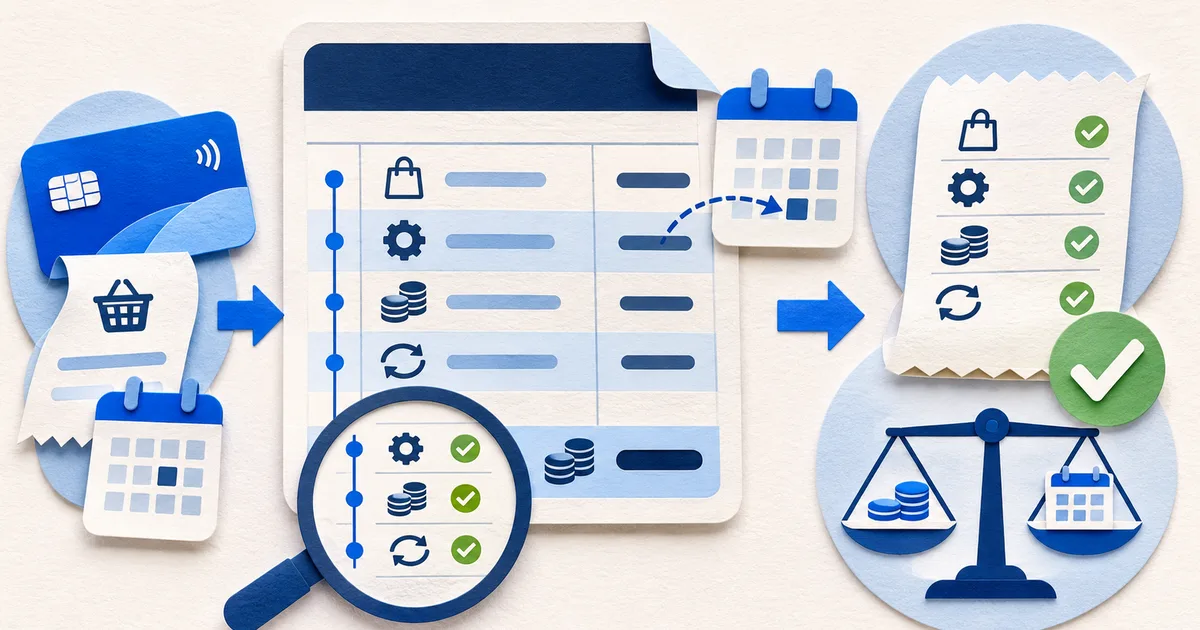
Scope of Balances, Billing Dates, Fees, and Adjustments
The path distinguishes statement, current, available-credit, minimum, and past-due figures; transaction and posting dates; pending and settled states; and the event trail behind fees, interest, refunds, and reversals.
Timestamp every balance
Record its exact issuer label, source, observation time, cycle cutoff, and whether pending activity is represented.
Choose the date for the task
Receipt matching, statement inclusion, accounting, and behavior analysis can require different date fields.
Link corrections to causes
A refund, reversal, fee credit, or returned payment stays as a new event connected to the original.
Questions to answer before moving on
The review should explain each difference without changing an issued figure to agree with a later account view.
- What source and observation time belong to each balance?
- Which date determines inclusion for this particular decision?
- Can every adjustment be linked to its triggering event and rule?
Choose a balances, billing dates, fees, and adjustments guide
Open the guide that matches the decision or exception in front of you. Each page preserves its own source boundary and practical workpaper.
Begin with Transaction Date vs Posting Date on a Credit Card Statement when that question matches the statement in front of you. The transaction date usually marks when activity began; the posting date records when the issuer entered the settled event on the account.
Transaction Date vs Posting Date on a Credit Card Statement
The transaction date usually marks when activity began; the posting date records when the issuer entered the settled event on the account.
How to Review Credit Card Statement Fees and Interest
A card cost or adjustment should connect to a named event, disclosed rule, balance category, and place in the statement balance equation.
Test the method on an authorized statement
Apply the checks from this path to a statement you are authorized to process, and keep every conclusion connected to the issuer record.
Build a timestamped balance and event bridge
Name every balance exactly and record its source, cycle cutoff, and observation time. Start with the issued statement figure, apply later posted debits and credits, and list pending holds separately. Select transaction or posting date for a stated purpose rather than mixing the two silently.
Keep refunds, reversals, returned payments, fee credits, and disputes as new events linked to their causes. If a residual remains, investigate scope, special-plan balances, signs, and issuer presentation. Do not alter the closed statement to agree with a current figure that answers another question.
Create an event bridge that never overwrites an issued figure. Start with the labeled statement balance and closing timestamp. Add later posted purchases, advances, fees, and interest; subtract later payments, refunds, and credits; and list pending holds outside the equation. For every adjustment, retain the original event, correction date, amount, reason, and status. If the bridge leaves a residual, name it and investigate scope, sign conventions, special-plan balances, or a missing event. A balancing plug would erase the evidence needed to solve the difference.