
Credit Card Statement PDF, OCR, and Extraction Quality
Use this path when a statement must become structured data without breaking the trail back to its pages.
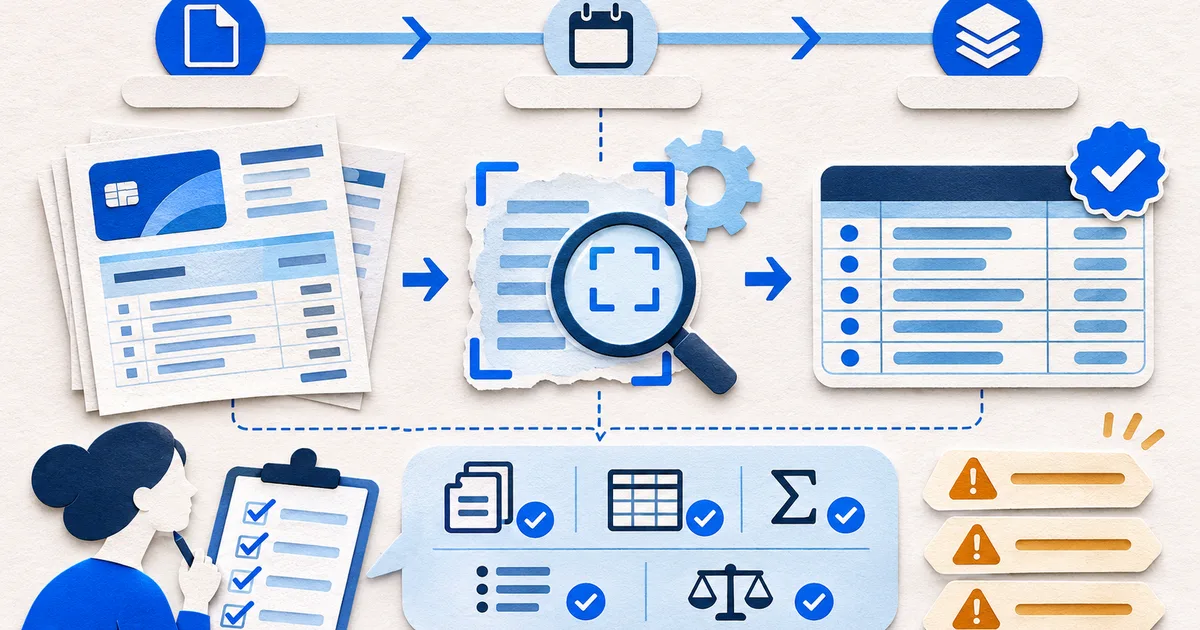
Scope of Credit Card Statement PDF, OCR, and Data Extraction
The focus is acceptance testing: document identity, readable pages, amount-column placement, transaction coverage, source references, reconciliation, and an exception log for every manual change.
Validate the input
A file must be the intended cycle, open completely, and show every page before OCR or table extraction begins.
Challenge high-risk fields
Sample decimals, signs, foreign values, wrapped descriptions, refunds, fees, and rows near page boundaries.
Approve the dataset
Compare row counts and debit and credit totals, then release the file with unresolved cells and corrections clearly recorded.
Questions to answer before moving on
A tidy table is not enough. Approval requires traceable rows, control totals, and explicit unresolved exceptions.
- Did each source page contribute the expected rows exactly once?
- Could any amount have shifted between debit, credit, balance, or fee columns?
- Can another reviewer reproduce every correction from a page reference?
Choose a credit card statement pdf, ocr, and data extraction guide
Open the guide that matches the decision or exception in front of you. Each page preserves its own source boundary and practical workpaper.
Begin with How to Analyze Credit Card Statement Data From Source to Finding when that question matches the statement in front of you. Begin with a card-specific evidence ledger that reproduces the statement balance. Interpret merchants, categories, and recurring patterns only after that control passes.
How to Analyze Credit Card Statement Data From Source to Finding
Begin with a card-specific evidence ledger that reproduces the statement balance. Interpret merchants, categories, and recurring patterns only after that control passes.
How to Check Credit Card Statement OCR Results
OCR is ready only when the extracted values can be traced to the same pages, fields, signs, and totals in the issuer's statement.
Quality-Control a Credit Card Statement Spreadsheet
A spreadsheet is ready only when it proves complete capture, preserves statement wording, reconciles to the card balance, and exposes every correction and uncertain field.
Test the method on an authorized statement
Apply the checks from this path to a statement you are authorized to process, and keep every conclusion connected to the issuer record.
Release extracted data through control totals
Treat the table as a proposed transcription. Validate file identity and pages, sample difficult cells, compare row counts, total debits and credits separately, and test available balance continuity. Keep source page, raw text, confidence, reviewer state, and correction reason beside every altered or uncertain field.
Approve only the uses the evidence can support. A dataset with one unresolved merchant may still support a balance total; a missing amount may not. Publish the open value, affected outputs, reviewer, date, and source version so downstream users cannot mistake partial approval for complete verification.
Use a release sample that deliberately includes the hardest rows, not merely the first page. Include a wrapped descriptor, a refund, a foreign amount, a fee, a decimal near a column edge, and the first and last row on a page. Compare character by character, then recompute separate charge and credit totals. Record the number of checked fields, the exact errors, corrections, unresolved cells, reviewer, and source version. A dataset is released for named uses only after the remaining uncertainty is visible beside every affected output.