
Credit Card Statement Fundamentals for a Complete Cycle Review
Begin here to understand what a card statement records, what it leaves outside the cycle, and how its sections work together.
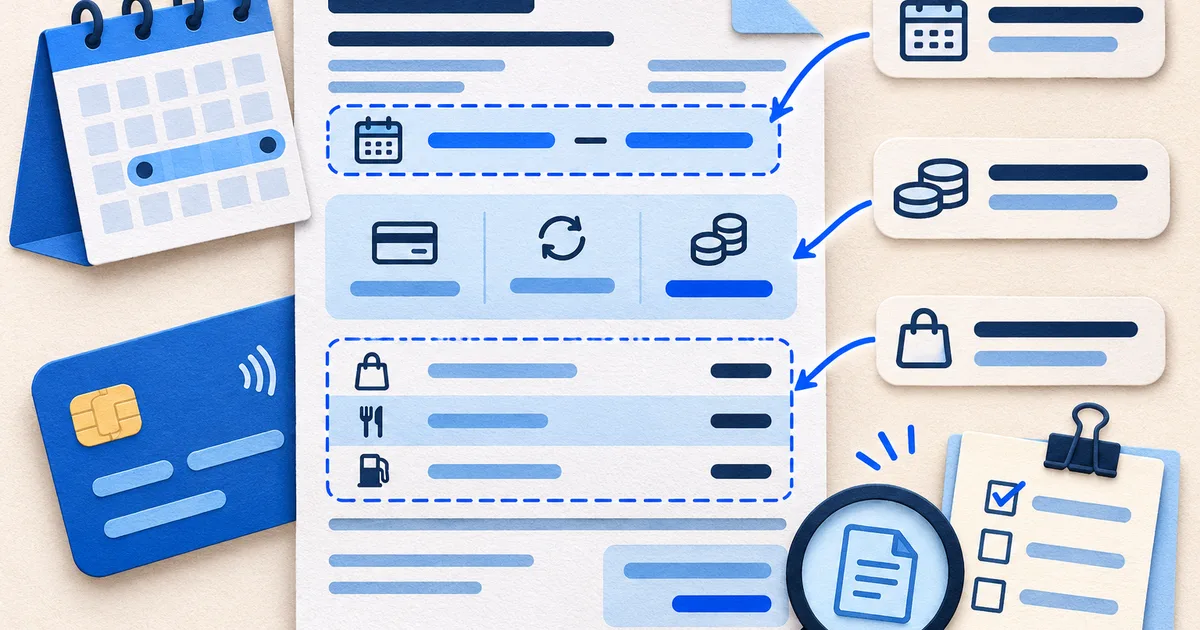
Scope of Statement Fundamentals
This path covers the issued billing record itself: account identity, closing dates, payment instructions, statement balances, posted activity, rate disclosures, and issuer messages. It also separates the fixed document from the changing account screen.
Establish the document
Confirm issuer, card suffix, currency, cycle dates, page sequence, and version before reading individual charges.
Give each balance one meaning
Keep previous, statement, current, minimum, available-credit, and past-due figures in their stated roles.
Read rows in context
Use full descriptors, both available dates, amount direction, nearby credits, and issuer legends before interpreting an event.
Questions to answer before moving on
You are ready to continue when the statement scope is proven and every important total has a named source field.
- Which closed period and masked card does this document cover?
- How do the activity classes bridge the previous balance to the new balance?
- Which figures are printed facts and which are later calculations or interpretations?
Choose a statement fundamentals guide
Open the guide that matches the decision or exception in front of you. Each page preserves its own source boundary and practical workpaper.
Begin with Credit Card Statement Abbreviations and Descriptor Codes Explained when that question matches the statement in front of you. A short code rarely tells the whole story. Read it with the amount, direction, merchant text, date, card suffix, and the issuer's own statement legend.
Credit Card Statement Abbreviations and Descriptor Codes Explained
A short code rarely tells the whole story. Read it with the amount, direction, merchant text, date, card suffix, and the issuer's own statement legend.
Credit Card Statement vs Transaction History: Which Record to Use
A statement is a closed billing-cycle record. Transaction history is a changing account view. Use the statement for what the issuer issued and the live view for activity after that cutoff.
Test the method on an authorized statement
Apply the checks from this path to a statement you are authorized to process, and keep every conclusion connected to the issuer record.
Use a source-first reading order
Begin with account identity, page inventory, and cycle dates. Transcribe the payment box and balance labels before reviewing rows. Next rebuild the balance bridge, then inspect transactions, costs, and issuer notices. This order prevents one dramatic charge from distracting from a wrong account, missing page, or misunderstood balance.
End with a short exception list naming unreadable fields, unmatched movement, uncertain descriptors, and later live activity. Give each item an owner and evidence request. Do not move into category or trend work until the issued record is complete enough for the decision being made.
Create a one-page reading record before making any judgment. Copy the masked suffix, currency, opening and closing dates, page count, previous balance, new balance, minimum due, due date, and every activity subtotal exactly as printed. Mark each value as an issuer fact, a calculation, or an unresolved interpretation. Then test whether the activity classes explain the balance movement. This record prevents a later reviewer from confusing a live account figure with the closed-cycle document and gives every exception a precise location.