
Credit Card Statement Explained Section by Section
A credit card statement freezes one completed billing cycle. Start with its identity and deadline, prove the movement from prior balance to new balance, and only then examine purchases, payments, credits, fees, interest, and notices.
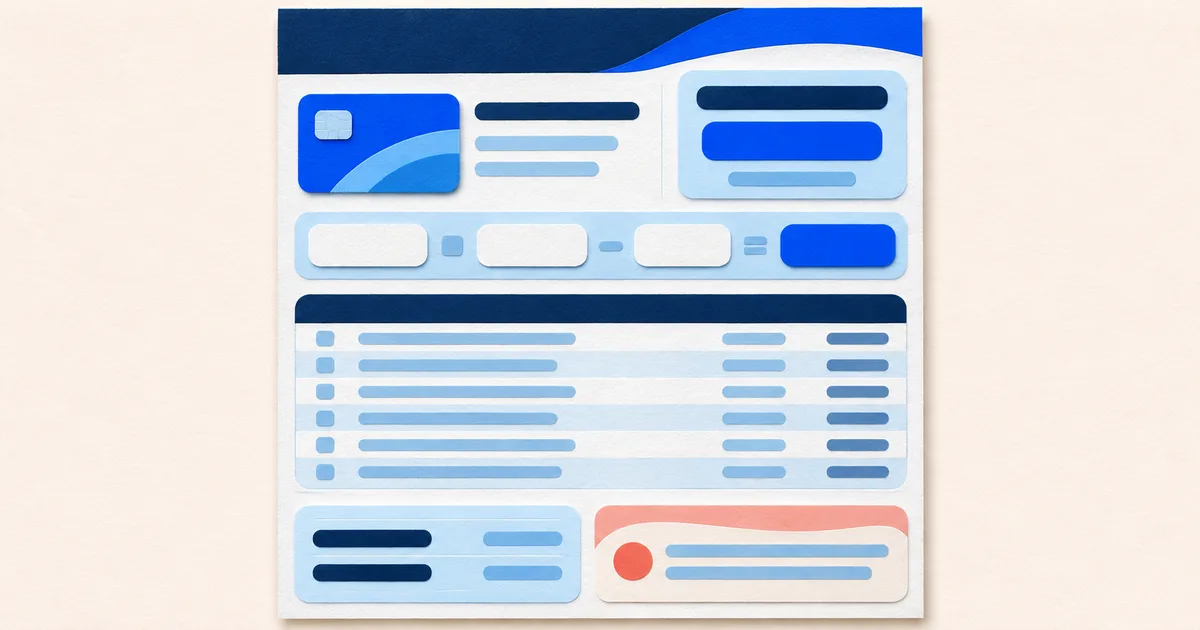
What a credit card statement tells you
The document joins three kinds of evidence: what the issuer says is payable, the posted events that moved the account, and the terms used to calculate charges. If a label is unfamiliar, use the credit card statement glossary before drawing a conclusion.
- The cycle dates define which posted transactions belong to the document.
- The payment box separates the statement balance, minimum payment, and due date.
- The transaction and interest sections provide the evidence needed to check the summary.
Use the issued statement as the source
A mobile account view keeps changing after statement close. Record its observation time and do not blend later authorizations or postings into the already issued cycle.
Use the four-pass reading methodRead a credit card statement in four passes
Four deliberate passes prevent a dramatic charge or balance from distracting you before the document itself has been validated.
Confirm identity and period
Match the named holder, masked suffix, currency, issuer, cycle dates, and page sequence. The credit card statement review checklist provides a repeatable evidence record when scope can be proved.
Rebuild the balance
Bridge the opening obligation to the closing obligation with every charge class and every reduction shown by the issuer. Use the statement balance versus current balance guide when a live figure includes activity after closing.
Copy the payment instruction
Transcribe each payment-box figure into its own field so a deadline is never confused with a balance or an automated-payment date. The minimum payment and due-date checks explain the evidence to preserve.
Inspect the activity
Inspect full rows and disclosures, then turn every unexplained amount into a named exception with supporting evidence and an owner. For settlement uncertainty, compare pending and posted credit card transactions before escalating the row.
Credit card statement anatomy
Issuer layouts vary, but a usable statement must let the reader locate the account and cycle, payment obligation, ledger activity, borrowing cost, credit position, and important changes.
Identity and billing period
Establish whose card record this is, which masked account it covers, when the cycle opens and closes, and how the issuer can be reached safely.
Amount and due date
Copy the new balance, smallest required payment, deadline, any amount already past due, and any special payment message.
Purchases and credits
Separate spending from cash advances, transferred debt, card payments, merchant credits, dispute credits, and issuer corrections.
Fees and interest
Identify each fee by cause and read interest beside the balance category and rate that produced it.
Limit and available credit
Compare the stated limit and remaining capacity while noting that holds and post-close activity may affect the live figure.
Rates and notices
Look for rate tables, promotional deadlines, calculation language, benefit changes, and account-specific issuer messages.
Check how the new balance was built
Reconstruct the cycle as an equation: opening obligation plus new debits and borrowing costs, less payments and credits, should land on the issuer's closing figure. Check the arithmetic with the credit card statement balance calculator without hiding a variance.
Separate the four payment-box decisions
These four figures answer different questions: the closed-cycle obligation, the least required cycle payment, a changing live account amount, and the deadline attached to the issued bill.
| Statement field | What it answers | What to verify |
|---|---|---|
| Statement balance | The issuer's closing figure for this completed period. | Confirm the cycle end and whether special-plan amounts are presented separately. |
| Minimum payment | The smallest listed payment for the cycle. | Paying only this figure can leave a balance that continues under the card's interest terms. |
| Current balance | A changing account figure that can include events after closing. | Record when it was observed and whether pending authorizations are excluded or shown elsewhere. |
| Payment due date | The calendar deadline attached to this cycle's obligation. | Read the accepted methods, cutoff clock, time zone, processing delay, and non-business-day rule. |
Review every transaction as a complete row
Treat the whole row as the unit of evidence. A convincing merchant name cannot compensate for the wrong date, amount, currency, suffix, or settlement state.
- Keep both available dates.The purchase and issuer posting can straddle a cycle boundary.
- Decode, but do not overwrite, the descriptor.Processors, marketplaces, parent companies, and terminal locations can mask the storefront.
- Connect every credit to an event.A partial return or delayed refund may not mirror the original wording or value.
- Preserve the currency trail.Retain original amount, converted amount, rate information, and separate foreign-use fees.
- Distinguish suspicion from proof.Flag lookalike and unfamiliar rows, then follow the official issuer review path.
Trace fees and interest separately
A fee is reviewed from the event said to trigger it; interest is reviewed from a rate, balance category, time period, and disclosed calculation method.
Interest charge
Place purchases, cash advances, transfers, and promotions in separate rate groups. The statement interest reconstruction guide shows how to compare a finance charge with the issuer's method.
Account fee
Name the charge, its apparent trigger, amount, posting date, and any linked tax, conversion, reversal, or waiver.
Promotional term
Capture the qualifying balance, promotional rate, final date, conditions, and rate stated to follow it without inventing missing terms.
If a charge is unfamiliar or incorrect
Preserve the row, rule out supported ordinary explanations promptly, and use the unfamiliar credit card charge review before escalating a still-unrecognized posted charge through the issuer's authenticated contact route.
Preserve the row
Save the exact text, dates, amount, currency, masked suffix, statement page, status, and nearby correction.
Check ordinary explanations
Ask approved card users and search receipts, wallets, subscriptions, marketplace orders, and travel records for a complete match.
Contact the issuer securely
Open the official app, type the issuer's known address, or use the number on the card. Do not trust contact details delivered in a suspicious message.
Track the case
Log every contact, case number, requested document, provisional adjustment, response deadline, and final account correction.
Credit card statement questions
These answers distinguish the issued billing-cycle record from live account figures and keep each statement amount in its correct role.
What is a credit card statement?
It is the card issuer's dated record of a closed billing period, bringing the payment obligation, posted ledger activity, credit position, borrowing costs, and account notices into one document.
How does a statement balance differ from today's balance?
The statement balance is fixed when the billing cycle closes. Today's balance can also include purchases, payments, credits, or reversals posted after that closing date.
What should I check first?
Prove that the statement covers the intended card and complete cycle. Then transcribe the new balance, minimum, due date, past-due amount, and limit before reviewing rows.
Does paying the minimum payment avoid interest?
Not necessarily. The minimum payment is the smallest cycle payment listed by the issuer, while avoiding purchase interest can require paying the full statement balance under the card agreement by the due date.
Continue with the statement review workflow
Use the glossary for an unfamiliar statement field, the credit card statement reference library for sourced explanations, or the private credit card statement analyzer when you are ready to examine one statement.