
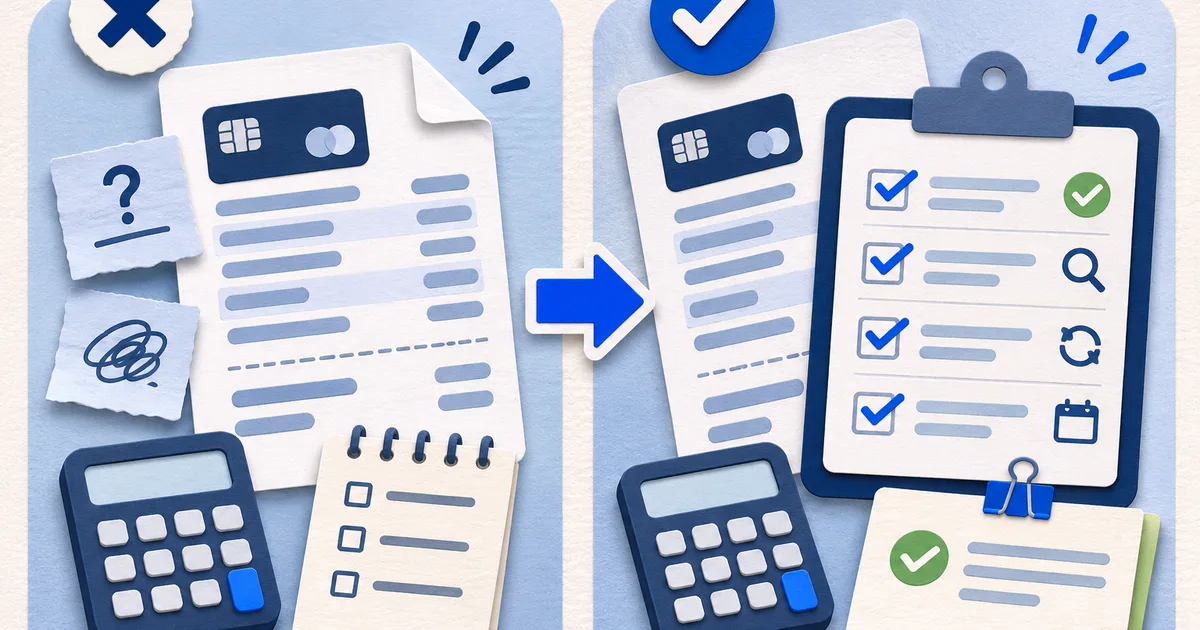
Draft one complete control
Use this anatomy for each checklist line.
Risk
The error or exposure to detect.
Procedure
A reproducible action using named fields.
Pass rule
The exact completion result.
Evidence
Page, calculation, sample, or reference.
Exception
Owner, status, escalation, and closure.
Define the decision
State whether the job concerns budgeting, bookkeeping, a dispute, tax support, or another purpose.
List credible failures such as a wrong account, missing page, duplicate charge, omitted payment, or exposed data.
Write observable tests
Replace review transactions with actions such as count pages, recompute the balance bridge, or sample foreign charges.
Give every test an exact pass condition and named evidence.
Scale depth to risk
Apply stronger checks to high-value, disputed, cash-like, foreign, or manually edited rows.
Set materiality and sampling rules before viewing results so the sample is not chosen for convenience.
Give failures a route
Every failed check needs an owner, evidence request, status, due date, and closure rule.
Separate timing differences, errors, and suspected unauthorized activity because their escalation paths differ.
Version and test the checklist
Record purpose, author, version, applicable account type, and review date, then retire obsolete copies.
Ask another reviewer to run a small sample and improve instructions that produce inconsistent answers.
Define the decision before listing controls. A monthly cardholder review may focus on payment obligation, unfamiliar charges, fees, and credits. A bookkeeping close also requires cutoffs, liability reconciliation, and supported entries. Record account, cycle, expected pages, source version, reviewer, due date, materiality, and required output so a lightweight review is not mistaken for accounting assurance.
Write each line as an observable procedure and pass rule. Instead of review balances, require the reviewer to copy the previous and new balance, total each activity class, calculate the bridge, compare it with the issuer figure, and record variance and page references. Instead of check transactions, define the sample or full-population tests and the exact evidence retained.
Classify controls by consequence. Missing pages, unreadable amounts, and unexplained balance variance can block downstream totals. A low-confidence merchant category may remain open while reconciliation proceeds. Give each failure an issue type, affected result, owner, evidence request, due date, escalation, and closure requirement. This keeps a labeling question from stopping all work and a structural defect from disappearing in notes.