
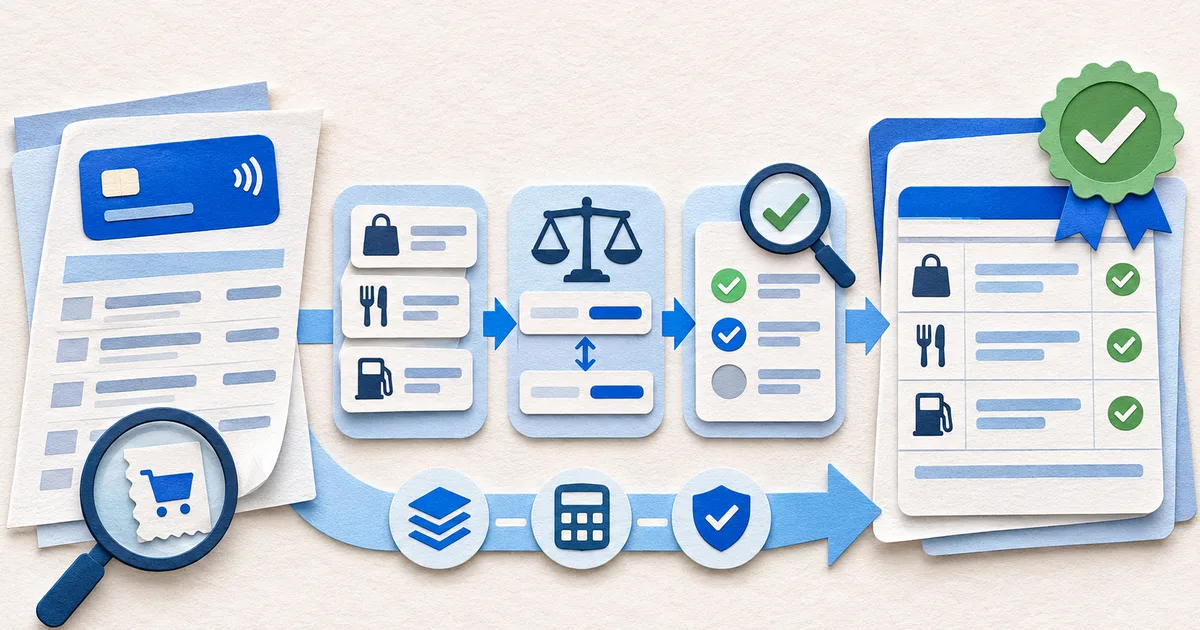
The three rules behind every result
The issued card statement is the control record. Our analysis remains a reviewable layer placed on top of it.
Copy before interpreting
Issuer fields and transaction descriptors are retained before any merchant cleanup or category suggestion is added.
Rebuild before explaining
Purchases, payments, credits, fees, and interest are totaled in their own roles before the new-balance bridge is assessed.
Expose what is uncertain
A blurred value, tentative merchant, or unmatched difference stays marked for review instead of being completed from context.
Which source wins
The original issuer PDF or image outranks extracted text, normalized fields, calculated labels, and user notes. A scan must pass an OCR quality check before its figures support analysis. For demonstrations, use the watermarked synthetic card statement; it is deliberately unsuitable as financial evidence. Unreadable cells remain empty and flagged.
What a transaction row contains
A review row can hold transaction date, posting date, issuer descriptor, possible merchant, debit or credit amount, currency, category, confidence, supporting link, source page, and reviewer note. The copied descriptor remains beside every added interpretation.
How merchant and category suggestions are bounded
A lookup uses a reduced descriptor after digits, long references, card endings, email addresses, and routine issuer terms are removed. The statement file, amount, balance, dates, account identity, and profile are not part of that request.
A category can be suggested only when the match has adequate confidence and inspectable support. Processor names, marketplaces, conflicting evidence, and weak aliases remain unresolved. The result shows the possible identity, reason, confidence, and evidence next to the untouched row.
How the balance bridge is tested
The worksheet starts with the previous balance, adds purchases, cash advances, transfers, fees, and interest, then subtracts payments and credits. The result is compared with the printed new balance, while issuer-specific signs and special plan balances remain visible.
What the browser-only calculators do
The category review, cycle expense worksheet, and card signal board calculate only from values typed into the current browser. They do not fetch an account, infer blanks, declare universal targets, or make a credit decision.
What enters the review pack
The private workpaper groups account and cycle identity, the balance bridge, transaction composition, extraction confidence, possible duplicates, open categories, warnings, and source-page references.
A duplicate marker means selected fields resemble another row. A zero variance means the captured arithmetic closes within tolerance. Neither result authenticates the document, proves ownership or purpose, or supplies audit assurance.
User notes are labeled as user-provided in screens and exports. They can explain context but cannot replace the issuer's wording, remove a warning, or establish tax treatment.
Evidence confirmations record a reviewer's stated checks; the service does not verify them. Excel output retains the ledger, summary, reconciliation, exceptions, controls, and relevant method limits.
Conclusions the data cannot make
A merchant match, category, recurring pattern, or closed arithmetic difference is not proof of what was purchased, who approved it, whether it was fraudulent, whether a subscription remains active, or how tax law treats it.
Tax-review candidates and scenario arithmetic
The tax worksheet can nominate a reviewed card row for further substantiation, but it never declares a deduction. Its default allowable proportion is zero because the statement cannot establish taxpayer status, business connection, attendees, reimbursement, mixed use, independent support, or the law for a year and place.
A user supplies the jurisdiction, year, verified marginal rate, and supported proportion. The browser applies the proportion to the charge and then the rate to that result. This narrow scenario is not a refund estimate and does not model credits, indirect taxes, capital rules, thresholds, losses, phaseouts, or local charges.
Jurisdiction notes link to current publications from the IRS, HMRC, CRA, ATO, and Hong Kong IRD. For another place or changed year, start with that authority's own guidance.
Public-page release control
A public page must have one clear reader task, aligned title and H1, accurate links, support for factual claims, original language, and enough practical depth to stand on its own. Drafts remain unavailable to search until editorial approval; repeated or insubstantial work is rejected.
Privacy and retention boundary
Guest source and output are encrypted, restricted to the browser session, and scheduled to disappear after 30 minutes. A signed-in user separately chooses whether to save a file. Free files expire after 30 days, paid files have no automatic expiry, and both can be removed earlier. The privacy policy describes the complete lifecycle.
Put the method into practice
Begin in the card statement workspace. Use the data-quality path to prove coverage, the reconciliation workpaper to explain differences, and the OCR acceptance checks for scans. Convert those decisions into a repeatable control with the review-checklist builder. Editorial investigations appear in Credit Card Statement Research.