
Share and Redact Credit Card Statements With Less Exposure
Use this path before a statement leaves the cardholder's control or enters a new storage system.
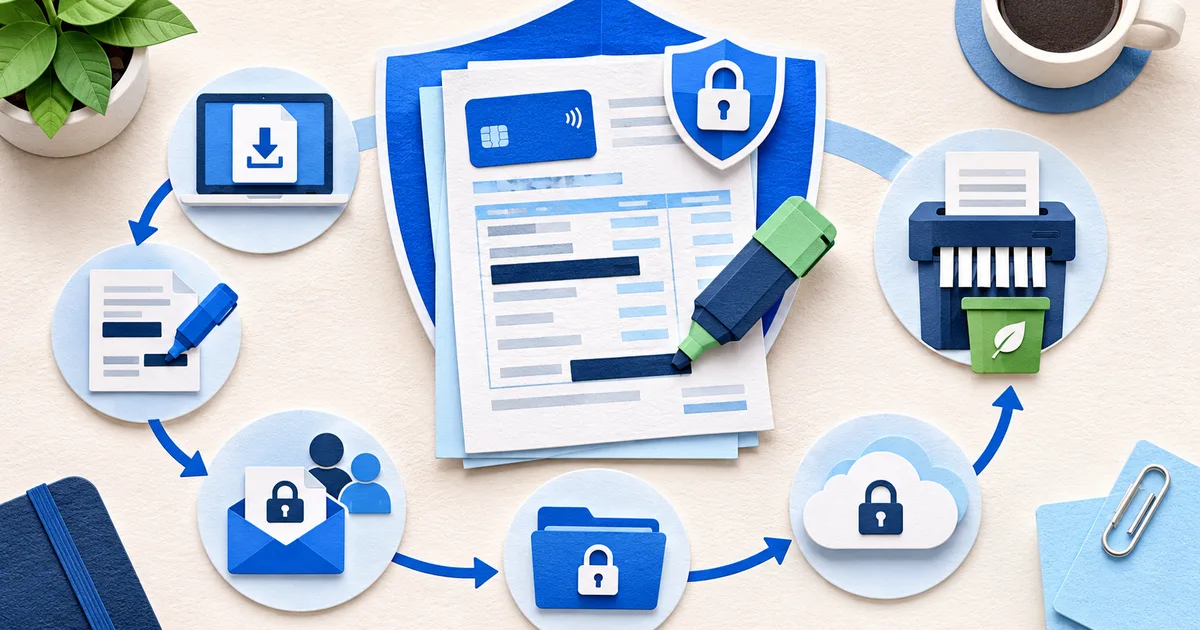
Scope of Share and Redact Credit Card Statements Safely
The material follows the complete disclosure lifecycle: requester verification, minimum necessary fields, working copies, redaction recovery tests, authenticated delivery, access expiry, retention, disposal, and incident response.
Minimize the copy
Ask which fields and pages the recipient truly needs, then remove unrelated material from a disposable version.
Prove redaction
Search, select, copy, inspect metadata, reopen in another viewer, and check every repeated header and page.
End the disclosure
Record recipient and version, revoke links, remove temporary copies, and follow an incident process if delivery goes wrong.
Questions to answer before moving on
A secure channel does not cure excessive content. Both the document scope and the transfer controls must pass review.
- Could a selected page or verified letter answer the request with less data?
- Can any hidden value be recovered from text, layers, metadata, or an earlier version?
- Who can access the delivered copy and on what date should that access end?
Choose a share and redact credit card statements safely guide
Open the guide that matches the decision or exception in front of you. Each page preserves its own source boundary and practical workpaper.
Begin with Credit Card Statement Privacy From Download to Deletion when that question matches the statement in front of you. Protecting a card statement means controlling the entire copy lifecycle, not only hiding the account number before it is shared.
Credit Card Statement Privacy From Download to Deletion
Protecting a card statement means controlling the entire copy lifecycle, not only hiding the account number before it is shared.
How to Redact a Credit Card Statement Without Leaks
A dark rectangle may hide pixels while leaving searchable text underneath. Safe redaction removes the data and tests the exported copy.
How to Share a Credit Card Statement Securely
Secure sharing begins before encryption: verify the requester, send the smallest useful record, and control who can open or keep it.
Test the method on an authorized statement
Apply the checks from this path to a statement you are authorized to process, and keep every conclusion connected to the issuer record.
Control the complete disclosure lifecycle
Verify the requester and purpose independently, list fields actually required, and create a recipient-specific copy. Use true redaction, then search, select, copy, inspect metadata, and reopen the final artifact elsewhere. A secure portal does not correct a document that contains unnecessary information.
Record exact version, recipient, channel, authentication, expiry, download permission, receipt, and revocation. Remove intermediate exports when the purpose ends and preserve only authorized records. If delivery goes wrong, act through the relevant incident process rather than assuming a requested deletion eliminated every copy.
Run a recovery test on the exact file that will be delivered. Search for sensitive digits, select and copy the covered area, inspect document properties and attachments, reopen the file in a second viewer, and check repeated headers on every page. Record the recipient, approved fields, file version, channel, authentication method, expiry, download setting, and revocation result. Delete intermediate exports when permitted. If the wrong copy was sent, preserve the incident facts and use the relevant response process instead of relying on an informal deletion promise.