How to Match a Credit Card Statement to Bookkeeping

Match statement and bookkeeping rows by event, not by a convenient amount. The account, direction, timing, currency, and supporting record should tell one consistent story.

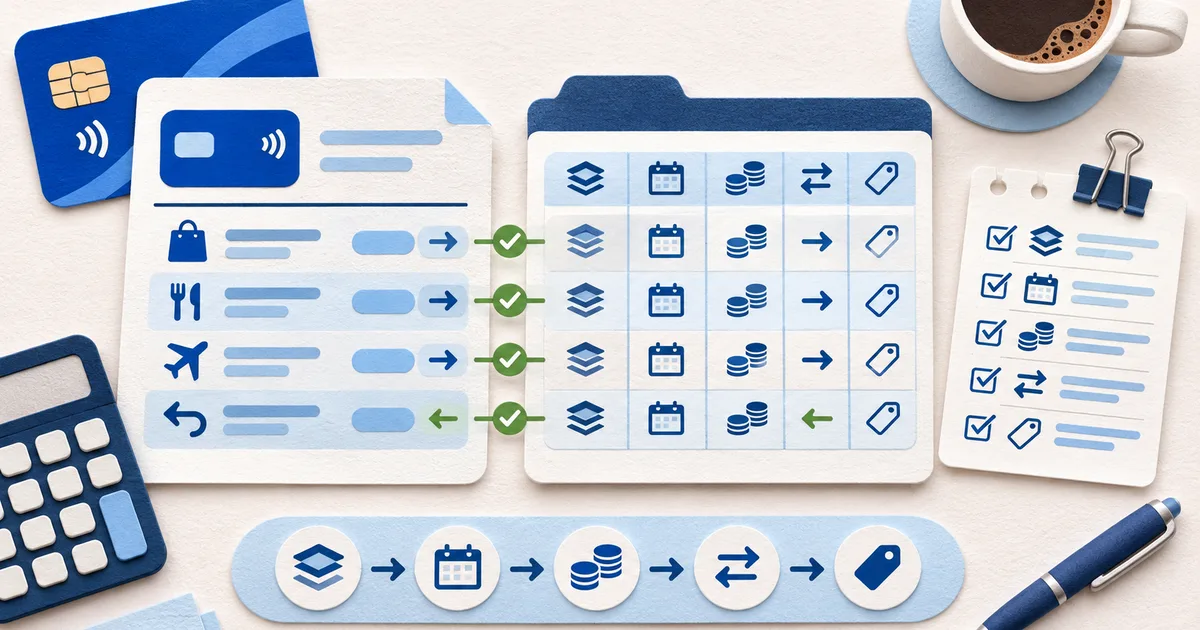
Accounting notes paired with corresponding entries from a fictional statement
Original editorial artwork for this guide. Any depicted account details are fictional.

Prepare both records at one cutoff

Export the statement ledger and card-account ledger through the same closing date. Confirm that each uses the same card account and currency before matching begins.

Separate pending commitments and unposted receipts from the posted control. They can be tracked as expected items without entering the closed-cycle match population.

Design a row-matching register

Give every proposed match a basis and a review state.

Statement key

Page, row, posted date, descriptor, amount, and direction.

Book key

Ledger ID, date, account, amount, and description.

Supporting link

Receipt, order, expense report, or payment confirmation.

Match type

One-to-one, one-to-many, many-to-one, timing, or unresolved.

Approval

Rule used, confidence, reviewer, and closure date.

Generate candidates with multiple fields

Use amount and direction together with a reasonable date window, merchant evidence, reference, currency, and card suffix. Treat exact amount alone as a candidate generator, not a completed match.

When descriptors differ, retain the issuer text and the book description. Add normalized merchant information in another field rather than overwriting either source.

Handle one-to-many and many-to-one cases

A single card settlement can represent several itemized expenses, tips, taxes, or fees. Several statement entries can also belong to one travel event or purchase order.

Use receipts and allocation records to document the relationship. The match should show how component amounts reach the source total without unexplained rounding plugs.

Route exceptions by cause

Use distinct queues for timing, missing support, wrong account, duplicate book entry, incorrect amount, return or reversal, foreign conversion, and disputed activity. Each cause needs a different next action.

Do not delete a row from the workpaper because it is inconvenient. Retain its source, status, owner, and resolution history.

Validate the match set as a whole

Compare matched and unmatched counts, debit and credit totals, and the final account balance. Sample automatic matches and review every unusual or material item.

Save the matching rules and output version. A later rerun should be reproducible and should not silently change decisions already reviewed.

Assume the books record 3,000 in card sales, while the bank side shows one 2,940 settlement and the processor report lists a 60 fee. A nearest-amount method leaves the deposit unmatched or understates revenue. Group the gross sales, fee, and net settlement as one supported event while retaining all three values, dates, account codes, references, and source documents.

Matching lab: connect a gross batch to a net deposit

Set matching rules before reviewing exceptions. Exact reference and amount can support a direct match; a date window may allow settlement delay; grouped matches need a documented composition. Equal amounts without compatible direction, account, counterparty, and timing remain candidates. One payment can clear through several debits, and several sales can settle as one deposit, so one-to-one matching cannot be assumed.

Classify every unmatched item. A statement-only fee may require a book entry; a book payment may be outstanding; a duplicate may need reversal; a transfer may belong to another owned account; an unknown amount may need evidence rather than adjustment. Record proposed treatment, owner, support, posting date, and closure requirement. Temporary suspense items stay open until a later record resolves them.

Complete the reconciliation by comparing adjusted balances and reviewing old exceptions from their original dates. Preserve the statement, ledger extract, matching schedule, processor report, posted entries, reviewer, and completion time. If an item clears later, link the later evidence to the original exception instead of changing its first status. That history explains both the period close and the eventual resolution.

Separate transaction identity from accounting treatment. A confirmed merchant and amount can still be posted to the wrong expense, tax, department, or project account. The statement match proves the bank-side event; an invoice, receipt, approval, and policy support the ledger coding. Keep these conclusions in different fields so a successful reconciliation is not mistaken for proof that every book classification is correct.

Use cutoffs consistently for both liabilities and payments. A payment initiated before statement close may post after it, while a book entry created on initiation can be outstanding at cutoff. Record initiation, bank posting, card posting, and book dates where relevant. The reconciliation schedule should explain the timing bridge and clear it in the later period without duplicating the payment.

Finally, separate preparation from approval where risk justifies it. The person who proposed a grouped match or adjustment should leave enough evidence for another reviewer to challenge the cutoff, account, amount, and coding. Approval records the scope and exceptions that were examined, not a generic tick. This review trail makes future period roll-forward safer and exposes recurring causes that deserve a process fix.

A payment, refund, or reversal should be classified with the transfers, refunds, and reversals review before it is matched to a book entry.

For a plain import file with visible review status, prepare a checked credit card statement CSV ledger and test it in a temporary account first.

The next closely related decision is covered in How to Review Credit Card Transfers, Refunds, and Reversals. Rows that fund, move, or undo money need an event identity before they receive a spending category.

Continue with a statement review

When the evidence is ready, use the structured card ledger export and leave every uncertain field visibly unresolved.

Open the related tool