
Tax Recordkeeping With Credit Card Statements
This path explains the supporting role of a statement without treating a posted charge as proof of deductibility.
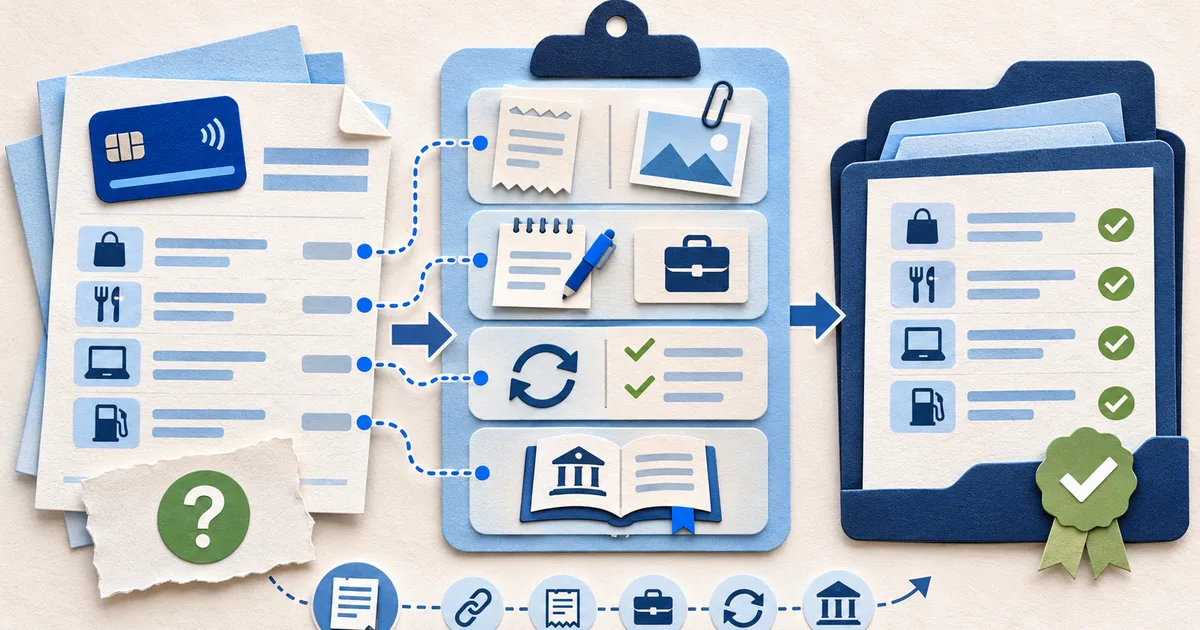
Scope of Tax Recordkeeping from Credit Card Statements
It covers transaction evidence packets, tax-year indexes, missing cycles, refunds, mixed-use allocation, bookkeeping links, retention decisions, access control, and dated official guidance.
Keep the card row unchanged
The source establishes a posted amount and context; receipts and invoices establish the item and supplier.
Document purpose and treatment separately
Ownership, business connection, allocation, period, and legal treatment belong in review fields, not edited statement text.
Build a retrievable archive
Index cycles, evidence links, open support gaps, retention rules, and authorized storage locations.
Questions to answer before moving on
The record is ready only when a reviewer can trace from reported treatment to support and back to the exact statement row.
- What independent record shows what was bought and why?
- How was any business or allowable share calculated?
- Which current rule governs treatment and how long must the evidence be kept?
Choose a tax recordkeeping from credit card statements guide
Open the guide that matches the decision or exception in front of you. Each page preserves its own source boundary and practical workpaper.
Begin with How Credit Card Statements Support Tax Records when that question matches the statement in front of you. A statement can support when and how an amount posted, but it rarely establishes the item, purpose, or tax treatment by itself.
How Credit Card Statements Support Tax Records
A statement can support when and how an amount posted, but it rarely establishes the item, purpose, or tax treatment by itself.
How to Document Expenses From Credit Card Statements
A statement can show that a charge posted to a card. It usually cannot prove what was bought, why it was incurred, who used it, or how tax rules treat it.
How to Organize Credit Card Statements for a Tax Year
A tax-year card archive should prove which cycles are present, connect selected charges with supporting records, and keep unresolved gaps visible.
Test the method on an authorized statement
Apply the checks from this path to a statement you are authorized to process, and keep every conclusion connected to the issuer record.
Build a two-way evidence trail
Use the statement row as a posted-payment locator, then attach the receipt or invoice, item detail, user, purpose, approval, allocation, refund history, accounting entry, and current rule consulted. Keep the gross card row unchanged and show any supported share in a separate workpaper.
Test from reported amount back to source and from source forward to treatment. Maintain a cycle inventory, evidence-gap queue, retention basis, and disposal review. Missing support remains open or excluded; the arrival of a deadline does not turn a merchant name into proof of purpose or deductibility.
For each potentially relevant row, assemble a compact evidence packet: unchanged statement entry, receipt or invoice, item detail, purchaser or user, stated purpose, allocation workpaper, refund history, bookkeeping reference, and the dated official rule consulted. Index the packet from the tax-year register and link it back to the exact cycle and page. Record missing support as an open gap or exclusion. A card statement can locate payment activity, but it does not by itself establish ownership, purpose, allocation, or legal treatment.