
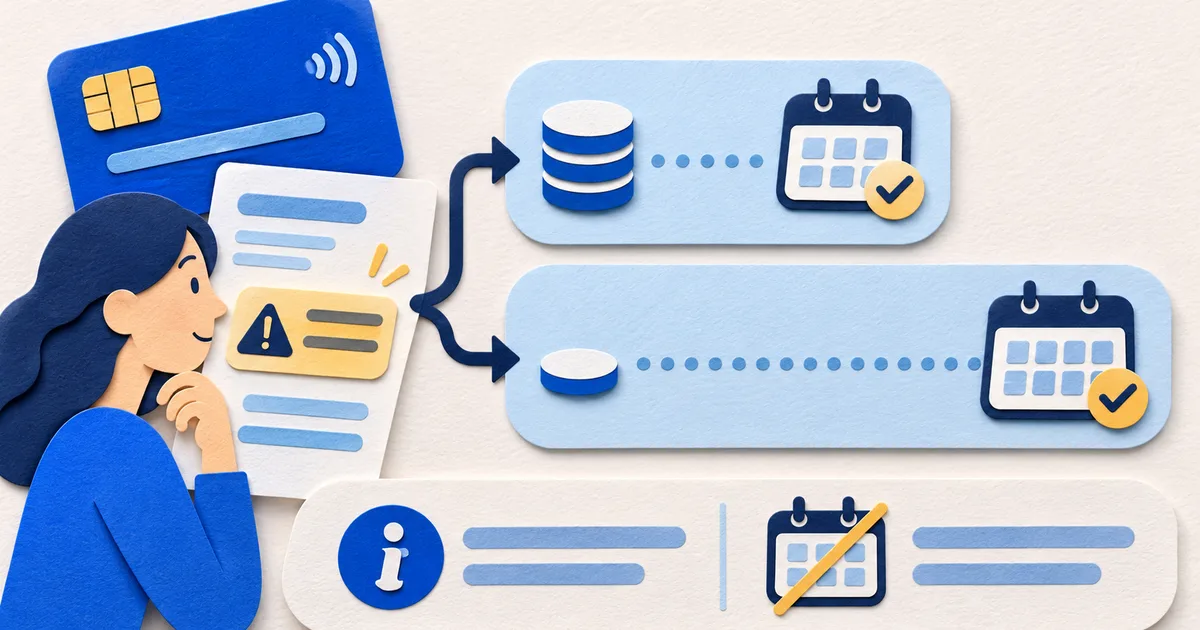
Identify complete scenarios
Locate the minimum-only example and any example using a larger fixed payment.
Read payment, payoff time, and total paid across one column instead of mixing figures from different scenarios.
Read the assumptions
The estimate may assume on-time payments, no new transactions, and specific interest conditions.
Variable rates, fees, cash advances, promotions, and fresh purchases can change the actual result.
Compare cost and time
Calculate the difference in estimated total payments and payoff time between displayed options.
Keep both results labeled as estimates because issuer allocation and rounding rules can affect them.
Transcribe the warning accurately
Separate issuer scenarios from your plan.
Minimum
Payment rule, payoff time, total, and assumptions.
Higher amount
Payment, payoff time, total, and assumptions.
Difference
Estimated months and dollars saved.
Account
Balance, APRs, due date, fees, and activity.
Plan
Chosen amount, funding check, and review date.
Connect it to the account
Check the actual balance, minimum due, due date, APR categories, and recent activity.
A static illustration may not include purchases made after the statement closed.
Choose a feasible rule
Select an amount that meets the issuer requirement and fits verified cash flow, then protect the funding account.
Revisit it after rate changes, new charges, a missed payment, or a promotion ending.
Transcribe each payoff scenario as a complete column: payment rule or amount, estimated payoff time, estimated total paid, and stated assumptions. Do not pair the monthly amount from one column with the total cost from another. Confirm that the warning belongs to the current card suffix and cycle, especially when several saved statements show different balances or rates.
List the assumptions before comparing outcomes. The issuer example may depend on on-time payments, no new transactions, unchanged interest conditions, and a specific balance. New purchases, variable APR movement, cash advances, fees, promotions, payment allocation, and a missed payment can change actual time and cost. Preserve the issuer's wording rather than presenting the example as a personalized forecast.
Calculate differences in both time and estimated total paid, but keep them labeled as scenario differences. Rounding and issuer methods can prevent a hand calculation from reproducing every cent. If a fixed higher-payment example appears, check whether the amount includes the minimum, whether it changes over time, and whether the issuer states any conditions for the estimate.