
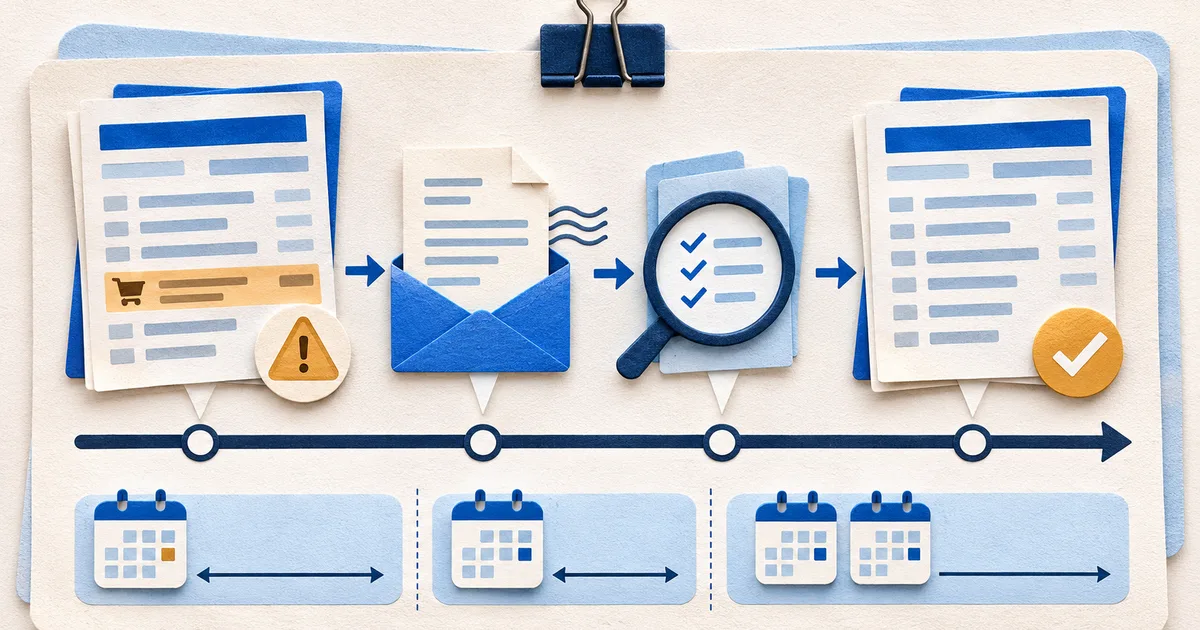
Timeline worksheet: first statement through final response
Dates below are procedural checkpoints, not a promise about a particular outcome.
| Evidence or step | Value or event | How to read it |
|---|---|---|
| Day 0 | First statement sent | Save the statement containing the alleged error. |
| Within 60 days | Written notice arrives | Use the designated billing-inquiries address and retain proof. |
| Within 30 days of receipt | Acknowledgment | Required unless the issuer completes the resolution sooner. |
| Within two billing cycles, max 90 days | Resolution | Review the written result and all resulting statement adjustments. |
Preserve the dispute record
Save the first statement where the alleged error appeared.
Use the billing-inquiries address rather than assuming the payment address works.
Send copies of supporting evidence and retain delivery proof.
Pay undisputed amounts and monitor every statement during the investigation.
Distinguish a provisional credit from the issuer's final written decision.
Official sources used for this page
These sources explain federal consumer rules or common contract terminology. Your own card agreement and issuer records control account-specific rates, classifications, deadlines, and decisions.
Classify the problem before writing
A billing error can include an unauthorized charge, the wrong amount or date, a charge for goods not accepted or delivered as agreed, or a payment or credit not properly posted. A merchant-quality disagreement, identity theft, and a debit-card transaction can involve different or additional procedures. Identify the account and transaction type first.
Describe only what the evidence supports. Record the merchant descriptor, amount, transaction and posting dates, statement date, and why it is wrong. If the merchant has agreed to a refund, preserve that communication and do not assume a pending refund stops the federal notice clock.
Anchor the 60-day period to the first statement
The critical reference is generally when the issuer sent the first statement on which the billing error appeared, not when the cardholder first noticed it or when a later collection message arrived. Save that statement and its delivery evidence if available. Act immediately rather than calculating to the last possible day.
A call or online submission may be useful and may be accepted by the issuer, but official consumer guidance recommends written notice to protect billing-error rights. Use the billing-inquiries address printed on the statement, which may differ from the payment address. Keep a copy and proof of delivery.
Build a complete evidence packet
Include the cardholder's name, account identifier as instructed, disputed amount, transaction date, and a clear explanation. Attach copies rather than original receipts, order confirmations, return records, cancellation notices, or merchant messages. Redact unrelated sensitive details where possible while leaving the relevant evidence readable.
Create an event log with every call, online submission, letter, delivery record, and issuer response. Note the date, channel, person or reference number, and promised next step. This log makes the investigation traceable and prevents a provisional adjustment from being mistaken for a final resolution.
Understand what happens during the investigation
After receiving a qualifying notice, the issuer generally has 30 days to acknowledge it unless the matter is resolved sooner, and up to two billing cycles, not more than 90 days, to resolve it. The disputed amount may remain visible on statements with a notation. Issuer interfaces may also show a temporary or provisional credit.
Do not assume every temporary credit is final. Continue reviewing each statement and pay the undisputed amount according to the agreement. Official guidance states that the disputed amount and related charges can generally be withheld during the investigation, but account-specific payment questions should be confirmed with the issuer and documented.
Read the final decision and next statement
If the issuer agrees, verify that the charge and related interest or fees were removed as applicable. If it finds the bill correct, it must explain why in writing and state the amount owed and when it is due. Compare that explanation with the evidence packet and the new statement.
A previously issued provisional credit can be reversed after an adverse decision. Label each adjustment as temporary or final based on issuer communication. If you disagree, review the stated appeal or response period promptly and consider filing a complaint with the appropriate regulator or obtaining legal advice for the specific circumstances.
Keep the analyzer in an evidence role
Statement analysis can locate the charge, compare duplicate amounts, identify connected fees, and assemble dates. It cannot determine whether a transaction was authorized or decide the legal merits of a dispute. Merchant names can also be truncated or processed by a parent company.
The most useful output is a neutral dispute worksheet: source statement, transaction record, reason supplied by the user, supporting documents, notice deadline, correspondence log, and adjustment history. Avoid altering the original PDF. Keep the original and a separately annotated copy so the evidence chain remains clear.
If the same amount appears more than once, compare transaction identifiers, posting dates, locations, and reversals before calling it a duplicate. Two equal purchases can be valid, while one authorization and one final posting can look repetitive in an account interface. The dispute reason should reflect the verified pattern, not only the repeated number.