
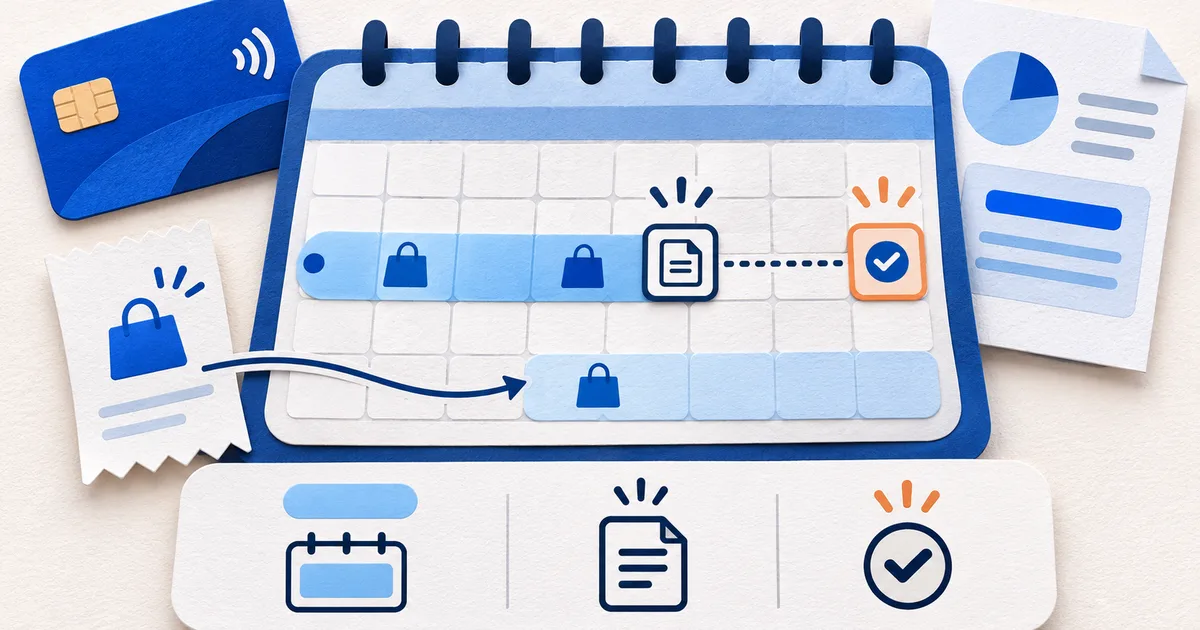
Worked timeline: one purchase across two statement cycles
Assume a statement covers March 13 through April 11, closes April 11, and has a May 6 due date. A $120 purchase is authorized April 11 but posts April 12.
| Evidence or step | Value or event | How to read it |
|---|---|---|
| March 13-April 11 | Billing cycle | Only posted activity assigned to this closed cycle belongs in its statement ledger. |
| April 11 | Closing date | The issuer calculates the statement balance and payment information. |
| April 12 | $120 posts | The purchase normally enters the next cycle and changes the current balance. |
| May 6 | Due date | The required payment for the statement that closed April 11 is due under the issuer's instructions. |
Start with the statement period, not the calendar month
A billing cycle is the span between one statement opening date and its closing date. It often resembles a month but may begin and end in the middle of calendar months. When you total spending, fees, or payments from a statement, label the result with the exact cycle dates. Calling a January 14 to February 12 cycle “February spending” can hide part of January and include only part of February.
The opening balance normally connects to the prior statement's ending balance, subject to later corrections or timing differences. Transactions posted during the cycle then change that balance. A strong review first confirms the period, then checks whether every transaction being analyzed has a posting date inside it. That sequence is more reliable than grouping rows by the month printed beside the due date.
What the closing date fixes
The closing date ends the measurement window and produces the statement balance, minimum payment, payment due date, and disclosures for that cycle. Activity after closing can change the account's current balance without changing the already-issued statement balance. This is why an app may show a current balance that is higher or lower than the amount on a PDF statement.
Closing is also the dividing line for utilization reporting and rewards in some issuer processes, although issuer practices can differ. The statement itself proves the cycle and the balance it reported; it does not prove when an issuer reported data to a credit bureau or how rewards will be handled. Use the card agreement or an issuer response for those account-specific questions.
What the payment due date controls
The due date is the date by which the issuer must receive at least the minimum payment under its stated payment instructions. The payment box should show both the due date and minimum amount. Paying only the minimum may avoid a late-payment problem, but it generally does not avoid purchase interest when a balance is carried. Paying the statement balance is a different action from paying the minimum.
Do not infer a due date by adding a fixed number of days to closing. Federal rules generally require periodic statements to be delivered at least 21 days before the due date for open-end consumer credit, but actual dates, cutoff times, weekends, and accepted payment methods still matter. Read the payment instructions printed on the statement and confirm the issuer's posting rules before a deadline.
Why a purchase may be absent from the statement
A purchase can be authorized before closing but post after closing. Pending transactions are not always included in the statement ledger or statement balance. The merchant may finalize a different amount, especially for restaurants, hotels, fuel stations, and rentals. Search the next cycle before treating an absent pending item as an error.
Use the posted date as the primary statement-placement clue, while preserving the transaction date if both appear. The two dates answer different questions: when the purchase activity occurred and when the issuer placed it on the account. An analyzer should not silently replace one with the other or force a pending authorization into a closed statement.
How to compare two cycles fairly
Compare exact cycle length before interpreting a spending change. A 28-day statement and a 33-day statement do not represent equal exposure to daily spending. Calculate a per-day figure when the difference matters, and separately note irregular purchases, refunds, annual fees, and travel. Keep the statement totals intact so the adjusted comparison remains traceable.
Also match the same transaction state and category rules across periods. One period built from posted rows cannot be fairly compared with another that includes pending activity. If a closing date shifted after an account change, annotate it rather than stretching the data to look like a calendar month.
A date-first review workflow
Record the opening date, closing date, due date, minimum payment, and statement balance in one header row. Then verify that transaction posting dates fit the period and that payments are not confused with purchases or credits. Finally, compare the closing statement balance with the current balance only after accounting for activity posted after closing.
This workflow separates evidence from interpretation. It can show that a charge belongs to the next statement or that a payment deadline is approaching, but it cannot decide whether an issuer will waive a fee, change a due date, or treat a payment exception favorably. Those decisions require the issuer's current policy and account record.
Date review checklist
Capture the exact opening and closing dates before totaling transactions.
Use the posted date to determine statement placement when both dates appear.
Keep statement balance, current balance, and minimum payment in separate fields.
Check the statement's payment cutoff and accepted-payment instructions.
Annotate different cycle lengths before making month-to-month comparisons.
Official sources used for this page
These sources explain federal consumer rules or common contract terminology. Your own card agreement and issuer records control account-specific rates, classifications, deadlines, and decisions.