
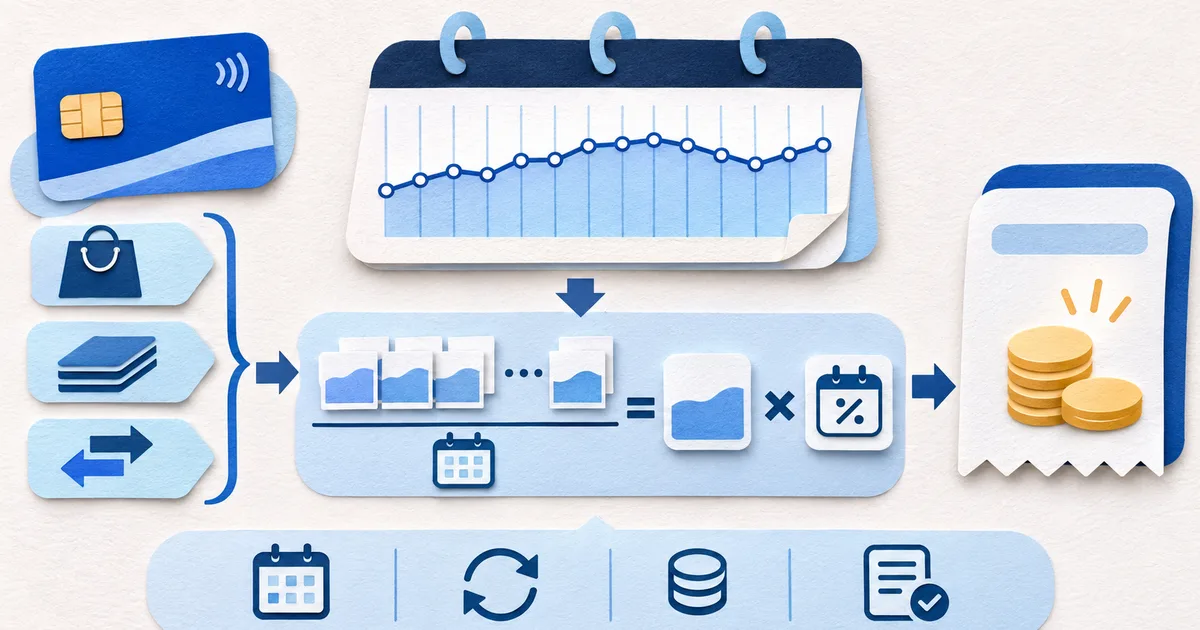
Worked example: a simplified 30-day purchase balance
Assume a 24.99% purchase APR, no grace period, and an average daily purchase balance of $1,200.
| Evidence or step | Value or event | How to read it |
|---|---|---|
| APR as decimal | 0.2499 | Convert 24.99% by dividing by 100. |
| Daily periodic rate | 0.00068466 | Divide 0.2499 by 365; retain extra precision. |
| Periodic factor | 0.0205398 | Multiply the daily rate by 30 cycle days. |
| Estimated interest | $24.65 | Multiply the periodic factor by $1,200, then round once. |
Recalculate without skipping an input
Separate purchases, cash advances, transfers, and promotional balances.
Use the exact cycle day count and disclosed daily periodic rate when available.
Build daily balances from posting evidence rather than guessed transaction dates.
Retain precision until the final currency rounding step.
Document the variance and uncertain assumptions instead of forcing a match.
Find the inputs before doing arithmetic
Collect the cycle opening and closing dates, number of days, APR for each balance type, balance subject to interest, and interest charged. Then collect every posted purchase, payment, credit, fee, and adjustment that changed the category being reviewed. If the statement provides only an average balance, you can check the final multiplication but may not be able to reconstruct each day.
Do not combine balance categories with different rates. A purchase APR, cash-advance APR, and promotional transfer APR can coexist on one account. The total interest line may be the sum of separate calculations. Treating the entire statement balance as if it carried one APR creates an apparently precise but usually misleading result.
Convert APR to a daily periodic rate
A commonly disclosed daily periodic rate is APR divided by 365, although an agreement may specify another denominator or method. Convert the percentage to a decimal before multiplication. For example, 24.99% becomes 0.2499; divided by 365, that is approximately 0.00068466 per day, or 0.068466%.
Retain more decimal places during the calculation than you show in the final result. Rounding the daily rate too early can create a visible difference across a long cycle or large balance. Compare your derived rate with the rate printed in the agreement or statement. When the issuer supplies a daily rate, use that disclosed value for the primary check.
Reconstruct the balance day by day
Begin with the category's opening daily balance. Apply each transaction according to the issuer's posting convention. A payment can reduce the balance from its effective date, while a new purchase can increase it. Record the ending balance for every calendar day in the cycle, including days with no activity. Sum those daily balances and divide by the cycle day count.
This is where most estimate differences arise. Transaction date and posting date are not interchangeable, and some agreements treat new purchases, fees, or prior interest in particular ways. If you lack a posting date, label the result as an estimate and test a small range of plausible dates rather than selecting the date that makes the interest match.
Apply the rate for the cycle
A simplified check multiplies average daily balance by daily periodic rate by the number of days in the cycle. With an average balance of $1,200, a daily rate of 0.00068466, and 30 days, the estimate is $24.65. The issuer may compound daily or use a more detailed method described in the agreement, so a small difference is not automatically an error.
Compare the result at the balance-category level. If purchase interest estimates to $24.65 and cash-advance interest to $6.10, compare $30.75 with the combined interest charge only after confirming there are no separate plan charges or adjustments. Preserve the components so a reviewer can identify which category caused the variance.
Diagnose a calculation that does not match
First check the cycle day count, rate conversion, sign of payments and credits, and effective dates. Next check whether the statement's balance subject to interest already represents the issuer's average daily balance. Finally, inspect prior-cycle balances, residual interest, fees added to a category, and promotional expiration dates.
Create a reconciliation note that states the issuer charge, your estimate, the variance, and the uncertain inputs. A difference of a few cents may be rounding; a larger difference may indicate a missing balance category or timing assumption. Ask the issuer for an explanation when material uncertainty remains instead of presenting your reconstruction as definitive.
Use the calculation to make a better review decision
The calculation can show how payment timing affects interest exposure. A payment earlier in the cycle can reduce more daily balances than the same payment near closing. That observation is descriptive, not a personalized payoff recommendation; cash needs, due dates, account terms, and other debts also matter.
For repeatable analysis, store the original transaction rows, their dates, the category APR, the formula, and the calculated output separately. Recalculate when source evidence changes. Never overwrite the issuer's statement interest with an estimated value, because both the reported amount and independent check are useful evidence.
Official sources used for this page
These sources explain federal consumer rules or common contract terminology. Your own card agreement and issuer records control account-specific rates, classifications, deadlines, and decisions.