
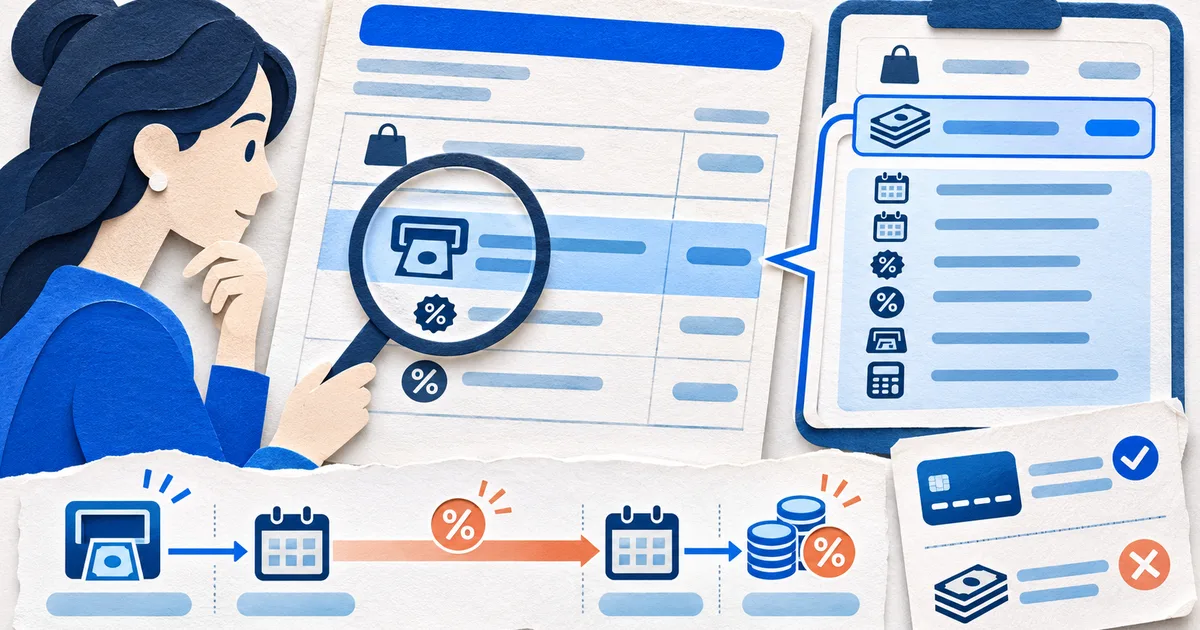
Cost map: a $300 ATM cash advance
This illustration separates the cash received from the charges that may surround it; actual rates and fees come from the statement and agreement.
| Evidence or step | Value or event | How to read it |
|---|---|---|
| Cash received | $300.00 | The principal placed in the cash-advance category. |
| Issuer advance fee | $15.00 | Illustrative 5% transaction fee; verify the disclosed minimum and percentage. |
| ATM operator fee | $3.50 | A separate fee may be imposed by the machine operator. |
| Accrued interest | Varies daily | Calculate using the cash-advance rate, effective dates, and issuer method. |
Find every component of the advance
Locate the ledger entry, then search the fee section for a cash-advance fee and the interest table for a cash-advance balance. An ATM operator can impose a separate fee that appears inside the withdrawn amount or as another transaction. The issuer may also cap advances below the card's overall credit limit.
Record the amount received, each fee, the date used by the issuer, and the balance category. Do not merge the issuer fee with interest: one is typically assessed for the transaction and the other accrues over time. Keeping them separate makes the total cost explainable and helps identify a duplicated or unfamiliar line.
Check the correct APR and day count
Cash advances often carry an APR different from purchases. Match the rate to the cash-advance row in the interest-charge calculation. Because a grace period commonly does not apply, daily interest may begin immediately even if the rest of the account normally avoids purchase interest.
Estimate the interest with the disclosed daily periodic rate, the relevant balance, and the number of days. A statement may use average daily balance or daily compounding, so the exact agreement matters. If the fee is added to the cash-advance balance, it may also affect subsequent interest depending on the terms.
Recognize transactions treated as cash equivalents
A cash advance is not always an ATM withdrawal. Some issuer agreements can treat convenience checks, wire transfers, money orders, person-to-person funding, gambling-related transactions, or other cash-like activity as advances. The merchant description alone may not reveal the classification.
Compare the ledger category, fee description, and balance table. If an ordinary purchase appears to have been treated as a cash advance, preserve the receipt and merchant details, then ask the issuer which agreement provision and transaction code caused the classification. Do not assume the merchant can change an issuer classification after posting.
Trace how a payment reduced the balance
Because the cash-advance APR is often high, the above-minimum portion of a payment may generally reach it before lower-rate balances. The minimum portion can be allocated differently. New interest and the effective payment date can mean the closing cash-advance balance does not equal the prior amount minus a simple share of the payment.
Use the next statement to reconcile opening cash-advance balance, new advances, fees assigned to that category, interest, allocated payment, credits, and closing balance. If the issuer does not show the allocation, request a breakdown. Keep your expected allocation distinct from the issuer's posted result.
Investigate an advance you do not recognize
Treat an unfamiliar cash withdrawal as urgent because it may indicate card or account compromise. Contact the issuer using the number on the card or official website, secure the account, and follow its fraud instructions. Preserve the statement, ATM location, timestamp, and any alert messages.
If the item is a billing error, follow the written-dispute instructions on the statement as well as any immediate phone or online report. Federal time limits can run from when the statement containing the error was sent. Use the designated billing-inquiries address, not automatically the payment address.
Report the true cost without overstatement
A useful cost summary includes the advance amount, issuer fee, operator fee, accrued interest through closing, and any continuing interest after closing. Show the period covered. Do not label the statement's interest as the final lifetime cost when the balance remains outstanding after the closing date.
The statement can support a historical cost calculation and highlight an ongoing balance. It cannot guarantee a current payoff amount. For that, request a dated payoff figure from the issuer and verify how new payments will be allocated across every APR category.
Keep cash-advance cost separate from ordinary purchase spending in summaries and exports. Otherwise a withdrawal can inflate a merchant category while its fee and interest disappear into general costs. A separate principal, fee, and interest record makes later reconciliation possible without changing the original statement row.
Official sources used for this page
These sources explain federal consumer rules or common contract terminology. Your own card agreement and issuer records control account-specific rates, classifications, deadlines, and decisions.
Cash advance cost review
Match the ledger entry to the cash-advance fee and APR category.
Record both the transaction date and posting date when available.
Check for a separate ATM operator charge.
Reconcile payment allocation on the following statement.
Report an unfamiliar advance immediately and preserve written-dispute rights.